aerOS continuum ontology
Introduction
The IoT-Edge-Cloud continuum managed by the aerOS Meta-OS represents a distributed computing architecture where data flows seamlessly from IoT devices at the edge of the network to centralized cloud infrastructure. The inherent complexity of this computing continuum needs to be modelled into a data ontology as easily as possible, being understandable by humans and also efficient for machine communications. In addition, there is a clear lack of existing ontologies for the computing continuum, and the minimal initiatives that have been found didn’t fit into the continuum conceived in aerOS. Therefore, an ontology for the IoT-Edge-Cloud continuum has been created from scratch for aerOS, inspired by some existing ontologies (e.g. FOAF ) and standardization initiatives such as OASIS TOSCA . This ontology is intended to encapsulate the essential concepts, relationships, and properties relevant to data management, processing, and orchestration within this distributed computing architecture.
The entities of this ontology can be divided into three blocks: (i) aerOS AAA, (ii) resource orchestration, (iii) service orchestration. The aerOS AAA block aims to represent the human side of the continuum, which in fact means the relationship between them and the services and resources that conform the continuum through the definition of users, roles, and organizations. On the other hand, the physical computing resources (Infrastructure Elements) must be represented in order to show the current state of the continuum by taking advantage of the defined monitoring processes. However, conceptual layers must be added on top of them to actually depict the defined continuum in aerOS, such as domains and Low-Level Orchestrators. The last block represents the deployed services in the IEs of the continuum. These entities not only represent the current status of this deployed services, but also all the stages of the services orchestration process, from service requirements specifications (SLAs, minimum computing resources, etc) to execution parameters (network ports, container images, environment variables…).
Finally, it is important to highlight that this is a live ontology that will be enhanced as long as the project progresses, so some parts of the continuum may not be covered yet or may even be expanded. In addition, this first consolidated version will need a proper testing process for tine-tuning. Therefore, this testing process has started along with the development of the MVP but will be improved in the next months as the development of the aerOS Basic Services evolves.
Conceptual model
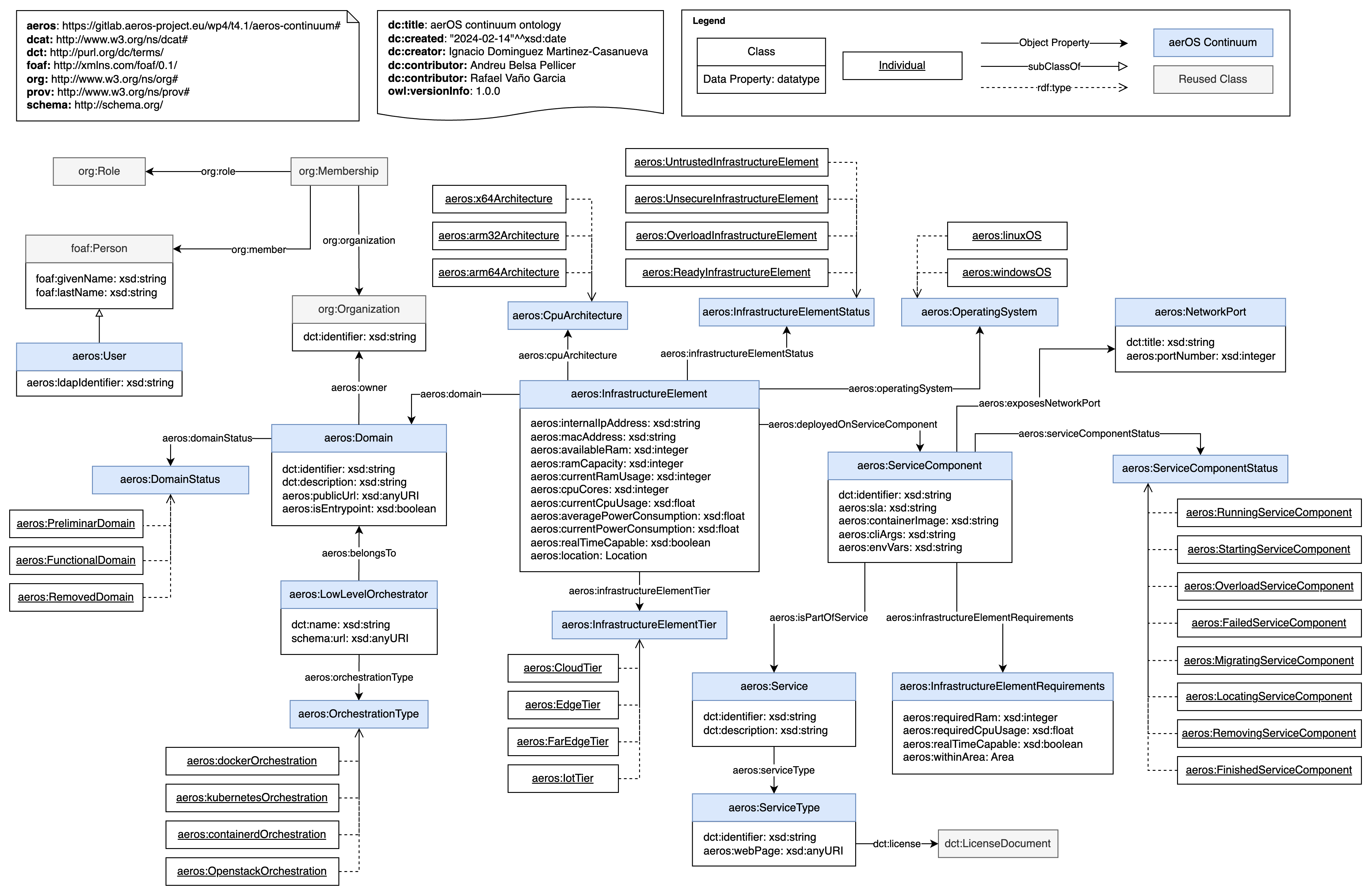
Ontology Specification Draft
The Ontology Specification Draft is available in this Gitlab page
This webpage has been automatically generated leveraging aerOS DevPrivSecOps features